
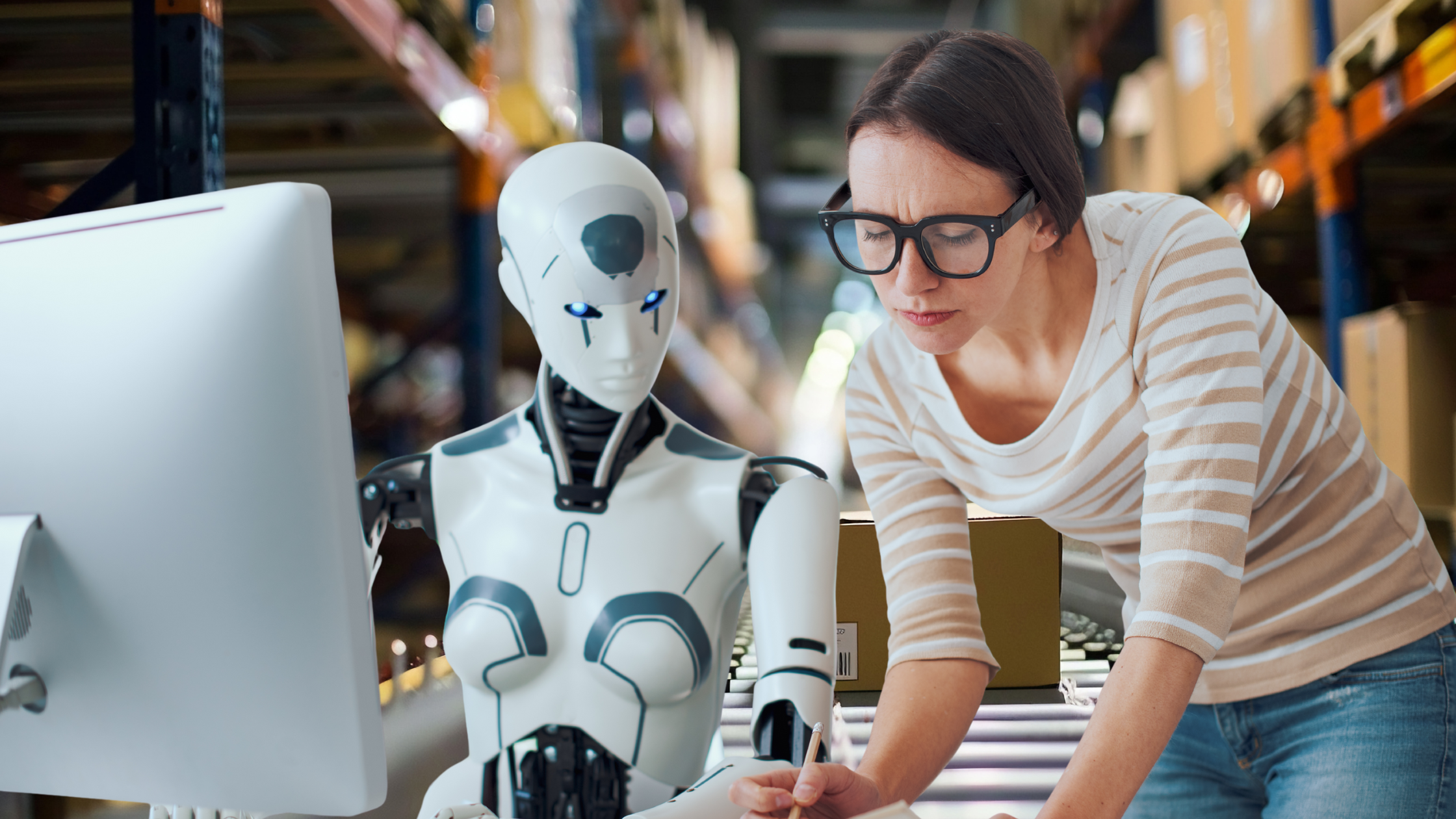
AI will take your job. Robots are replacing humans. Automation is the end of work as we know it.
If you follow headlines about artificial intelligence, you may be apprehensive about your career trajectory. Such forewarnings make for clickable news, but they miss a critical point, especially when we look at what’s really happening in the next phase of industrial evolution.
Industry 5.0 reveals a different outlook.
Rather than designing systems to push people out, Industry 5.0 is about putting people back at the center of industrial progress. It combines the speed and precision of advanced technologies like AI, collaborative robots (cobots), and digital twins with the uniquely human skills that machines can’t emulate: creativity, judgment, relationship-building, and ethical decision-making.
From Automation to Augmentation
Some years ago, Industry 4.0 brought us unprecedented levels of efficiency through automation. We learned to digitize, integrate, and scale production in ways that were impossible a decade earlier. But we also discovered its limitations. When industries suffered volatility, supply chain disruptions, climate shocks, and labor shortages, even the most automated systems faltered.
Today, Industry 5.0 flips the automation narrative. Instead of focusing on lights-out operations with minimal human involvement, Industry 5.0 is about designing systems to work with humans, augmenting their capabilities and freeing them from repetitive, low-value tasks.
When machines handle the mundane, people can:
- Make better decisions, faster.
- Apply expertise to complex challenges.
- Build and nurture critical relationships.
- Drive innovation and continuous improvement.
This human-in-the-loop (HITL) approach doesn’t just improve productivity. It strengthens resilience and gives us the ability to adapt, recover, and thrive in the face of disruption.
Fear vs. Reality: The AI Conversation We Should Be Having
Let’s address some of the most common AI fears head-on:
Fear: AI will take my job.
Reality: AI in Industry 5.0 is designed to complement people, not replace them. By automating repetitive work, time is freed for more strategic, judgment-driven tasks, which is exactly where humans excel.
Fear: Humans can’t keep up with AI.
Reality: The goal isn’t for humans to keep pace with AI; the goal is for AI to keep pace with humans, providing intuitive, timely insights that facilitate the decision-making process.
Fear: AI will erode creativity and collaboration.
Reality: Creativity, empathy, and relationship-building are human strengths that machines can’t replicate, regardless of how complex the technology. AI provides automation to support those capabilities, not replace them.
As I write in my white paper, Industry 5.0 vs. Industry 4.0: What Supply Chain Leaders Must Know for the Next 2–5 Years:
In the transition from Industry 4.0 to Industry 5.0, the most significant constraint isn’t technology. It’s talent. While 80% of supply chain leaders intend to pilot GenAI-enabled decision-making tools by 2025, only 27% report having a formal upskilling budget to support that transformation. This reveals a huge disconnect: Organizations are accelerating the deployment of advanced systems, yet leaving the human operators of those systems underprepared.
In an antifragile supply chain, the ability to adapt and thrive in the face of disruption relies not just on smart machines but on smart people who can interpret data contextually, collaborate effectively with AI, and make fast, confident decisions amid ambiguity. The workforce of Industry 5.0 must be interdisciplinary, systems-aware, and capable of navigating complexity – traits that cannot be outsourced to automation alone.
HITL in Action
The Industry 5.0 model is already delivering measurable results in supply chains:
- At Bob’s Red Mill, cobots powered by AI software took over heavy, repetitive palletizing tasks. This freed up four full-time employees per shift to take on more valuable work, thereby boosting productivity by 30% without reducing headcount.
- Siemens utilizes digital twin technology to provide frontline workers with real-time decision support. These digital replicas of physical systems allow teams to model disruptions before they happen, reducing downtime and improving agility.
These two examples also illustrate the importance of humans to the entire supply chain process. Humans are not being replaced; they are being given the opportunity to become more adaptable, effective, and valuable.
The Skills That Will Define Future Leaders
Technology is only half of the Industry 5.0 equation. The other half are people, more specifically, people equipped with the skills to thrive in a human-machine partnership.
The most in-demand skills for Industry 5.0 leaders include:
- Data literacy and AI ethics – understanding how to interpret, question, and use machine-generated insights responsibly.
- Cross-functional collaboration – working across departments and enabling digital transformation to help achieve real-world outcomes.
- Creative problem-solving – thinking beyond the obvious when disruptions happen.
Upskilling in these areas not only prepares teams for technological change, but it also develops the internal agility that’s essential for resilience.
Partnerships: The Hidden Driver of Resilience
Industry 5.0 aligns perfectly with one of the most important resilience principles: build resilience through better strategy and stronger partnerships.
When businesses strengthen their supplier relationships, invest in transparency, and align with partners on sustainability goals, they gain more than operational efficiency. They gain the ability to pivot quickly during disruption, secure priority access to resources, and maintain trust across the value chain.
In an era where disruptions are inevitable, those strong partnerships become a competitive advantage.
The Bigger Picture: Turning Disruption into Advantage
Industry 5.0 reframes disruption as a catalyst for growth rather than a threat to stability. By blending human creativity with intelligent technology, companies can move beyond resilience toward antifragility, the ability to emerge from challenges stronger than before.
This isn’t theoretical. Antifragility is a practical shift in mindset and operations, requiring us to:
- Measure technology success not just by efficiency gains, but by adaptability under stress.
- Use automation to enhance human decision-making, not bypass it.
- Align technology investments with sustainability and workforce development goals.
It’s Time to Lead the Change
AI is not the end of human input. It’s the beginning of a new chapter where technology amplifies human potential. Industry 5.0 offers a roadmap for turning fear into opportunity, and disruption into competitive advantage.
My new white paper, Industry 5.0 vs. Industry 4.0: What Supply Chain Leaders Must Know for the Next 2–5 Years, can help you:
- Understand the core principles of Industry 5.0.
- Build a strategy for human-AI collaboration.
- Identify partnerships that strengthen resilience.
- Develop an action framework for sustainable, antifragile supply chains.
Download the white paper and start building the human-centric, future-ready supply chain your business needs to thrive.
For more guidance on achieving antifragility, download my book, Antifragile Supply Chains: Building Resilience Through Better Strategy and Stronger Relationships,